
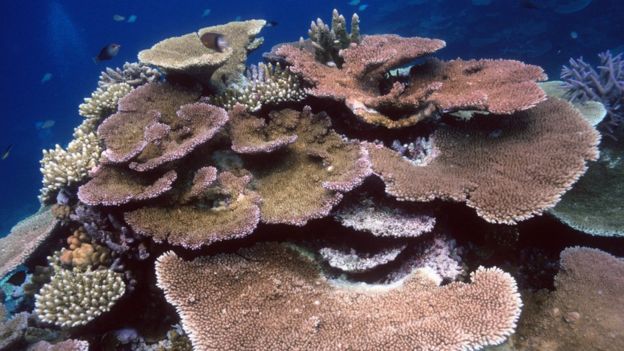

Coral cover in some areas of the Great Barrier Reef has declined by a third, new research shows.
In the southern region of the reef, coral cover dropped to 26.9 per cent, whilst it has also dropped by a quarter in the northern region, according to recent data from the Australian Institute of Marine Science (AIMS).
It marks a sharp decrease from the higher levels seen in recent years and has been caused by rising temperatures and severe weather events such as cyclones.
Dr Mike Emslie revealed the volatility in the reef showed the ecosystem was under stress.
“We are now seeing increased volatility in the levels of hard coral cover. This is a phenomenon that emerged over the last 15 years and points to an ecosystem under stress,” he said.
“We have seen coral cover oscillate between record lows and record highs in a relatively short amount of time, where previously such fluctuations were moderate.”
The reef has also been smashed by mass bleaching events, including one last year.
It was the fifth mass bleaching since 2016, and it is not a phenomenon seen just in the Great Barrier Reef.
“This year Western Australian reefs also experienced the worst heat stress on record. It’s the first time we’ve seen a single bleaching event affect almost all the coral reefs in Australia,” Professor Seline Stead from AIMS said.
“Mass bleaching events are becoming more intense and are occurring with more frequency, as evidenced by the mass bleaching events of 2024 and 2025.
“This was the second time in a decade that the Reef experienced mass bleaching in two consecutive years.
“These results provide strong evidence that ocean warming, caused by climate change, continues to drive substantial and rapid impacts to Reef coral communities.”
Stead believes the data is sending a strong message on what needs to be done to protect the vulnerable reefs in Queensland and beyond.
“The future of the world’s coral reefs relies on strong greenhouse gas emissions reduction, management of local and regional pressures, and development of approaches to help reefs adapt to and recover from the impacts of climate change and other pressures,” she said.































 The World Observer Media produces a daily online newspaper, a daily Arabic online newspaper and a monthly printed Arabic/English magazine and a weekly printed Arabic/English newspaper.
The World Observer Media’s mission is to entertain and educate all generation from the Ethnic Communities in Australia, who are interested in local, national and foreign information.
The World Observer Media produces a daily online newspaper, a daily Arabic online newspaper and a monthly printed Arabic/English magazine and a weekly printed Arabic/English newspaper.
The World Observer Media’s mission is to entertain and educate all generation from the Ethnic Communities in Australia, who are interested in local, national and foreign information.