
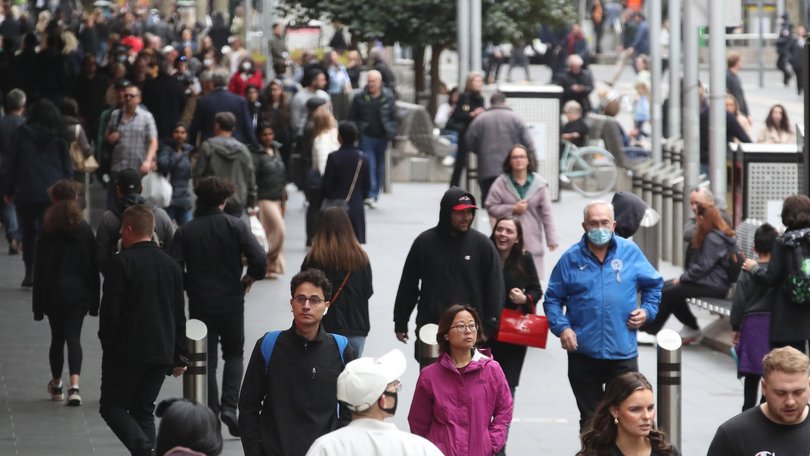

Australia’s population has reached 28 million, according to Australian Bureau of Statistics (ABS) estimates.
Its population clock forecast the nation had reached the milestone at 6am on Tuesday, based on the growth rate set on 1 July 2025.
The growth rate assumes that every minute and 15 seconds, another person is added to the Australian population.
Australia’s population growth in recent times has been largely driven by net overseas migration.
ABS figures released in March showed that, in the year to September 2025, net overseas migration accounted for 73 per cent of the nation’s population increase, or 311,000 people, while natural increase — births minus deaths — accounted for 27 per cent, or 112,600 people.
Liz Allen from the Australian National University’s Centre for Social Policy Research said migration continued to be a key contributor to Australia’s population growth, and the figure reflected changes to the immigration intake over time.
The March figures also showed Australia’s annual population growth rate in the year ending 30 September 2025 was 1.6 per cent.
Beidar Cho, demography director at the ABS, said the growth rate held consistently with the past two decades.
“That 1.6 [per cent] is actually a little below where we have been in recent years,” Cho said.
“And that’s because when the COVID pandemic hit, we had border closures, and then when the border reopened again, we had a peak in our net overseas migration.
“So the growth rate was a little bit higher in recent years, but it’s returned to around 1.6 per cent per year.”
Population growth across Australia
According to ABS data released in March, Western Australia recorded the fastest population growth in the year to September 30, rising 2.2 per cent, or about 66,000 people.
Queensland and Victoria both grew by 1.7 per cent, adding 97,300 and 122,000 people respectively.
The Northern Territory’s population rose by 1.4 per cent, or 3,700 people, while the ACT grew by 1.3 per cent, or 6,500 people.
South Australia added 21,100 people, up 1.1 per cent, while Tasmania recorded the smallest increase, at 0.3 per cent, or 1,700 people.
Australia’s birth rate
Last October, ABS data on fertility rates showed there were 1.48 babies per woman on average in 2024 — a record low and a dip from 1.5 the previous year.
“We have an ageing population, we are living longer, having fewer children,” Allen said.
She said that many Australians now opt not to have children due to barriers such as the high economic costs.
“There’s a deep sense of insecurity and fear about tomorrow,” Allen said.
Australia passed the 27 million milestone in 2024, about two years after international borders reopened, as net overseas migration rebounded from pandemic-era lows.
Australia is estimated to reach a population of 30 million people in 2031.
The 2026 Census will be conducted on the night of 11 August.























 The World Observer Media produces a daily online newspaper, a daily Arabic online newspaper and a monthly printed Arabic/English magazine and a weekly printed Arabic/English newspaper.
The World Observer Media’s mission is to entertain and educate all generation from the Ethnic Communities in Australia, who are interested in local, national and foreign information.
The World Observer Media produces a daily online newspaper, a daily Arabic online newspaper and a monthly printed Arabic/English magazine and a weekly printed Arabic/English newspaper.
The World Observer Media’s mission is to entertain and educate all generation from the Ethnic Communities in Australia, who are interested in local, national and foreign information.