
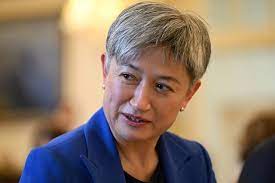

Historic relationships formed over hundreds of years between First Nations peoples and their Pacific neighbours offer Australia a “strategic national advantage”, Foreign Minister Penny Wong has told Garma Festival.
“Centuries before Europeans arrived, First Nations people connected Australia with the world,” Ms Wong told those gathered in north-east Arnhem Land for the second day of the nation’s largest Indigenous gathering.
“As Australia’s foreign minister, I am proud that this history — once under-utilised — is now part of Australia’s foreign policy.”
Ms Wong used her keynote address to emphasise her “shared vision for the Pacific region”, acknowledging Prime Minister of Timor-Leste Xanana Gusmão and leaders from the Marshall Islands, Kiribati, the Solomon Islands, Fiji, Papua New Guinea, Palau, and Tonga in the audience.
Penny Wong used her keynote address to emphasise her “shared vision for the Pacific region”.
‘We are not a monoculture and never have been’
Appearing on behalf of the prime minister, who was absent from the festival, Ms Wong rejected the idea of Australia as a ‘monoculture’ and emphasised Australia’s “common ground” with other countries.
“We are not a monoculture and never have been,” she said.
“That is why the Albanese Labor government has been determined to include more of Australia’s history and voices in our foreign policy.”
Prime Minister of Timor-Leste Xanana Gusmão also gave a keynote address.
As a Yanyuwa woman, Indigenous Australians Minister Malarndirri McCarthy described her own family’s cultural and trade connections to the people of Macassar.
“We taught them about the trees to use for the ropes to make,” she said in her keynote address.
“They taught us about the sails. We showed them where the trepang was.
“They would live with us for many, many seasons before they went back. And we would do the same.”
A focus on land rights
On the 50th anniversary of land rights, Ms McCarthy described the “alien moment” of her family having to prove their connections to the land.
“It was 50 years ago that the Yanyuwa people, my families, were the first to be tested under the Aboriginal Land Rights Act Northern Territory,” she said.
“I was only a little girl, but I remember my grandfathers, my Mimi (grandmother) and my Kurdis (grandfathers), my kujakas (mothers) all thinking and talking about how they were going to prove they were Yanyuwa and that they belonged to this land around the Borroloola region.
“How did they explain that their relationship has been there for thousands of years?”
Ms McCarthy acknowledged the previous announcement made by Gumatj Corporation leader Djawa Yunupiŋu.
As the ABC’s Matt Garrick reported earlier on Saturday, Mr Yunupiŋu used his Garma Festival speech to announce the creation of a breakaway remote Northern Territory land council to help drive direct economic development for his people.
“We are going to the top of the mountain,” Mr Yunupiŋu said.
The creation of the Dilak Land Council would put the ability to make economic development decisions into the hands of his people, and away from the powerful Northern Land Council (NLC) which oversees communities across much of the Top End.
‘The most beautiful unrequited letter of love in Australian political history’
Cape York Institute leader Noel Pearson used his keynote address to call for an overhaul of how remote Aboriginal communities are managed.
Mr Pearson last spoke at Garma festival in 2023, the year of the Voice referendum.
“The Uluru Statement from the Heart was our prayer to the Australian people,” he said on Saturday afternoon.
“There was hope in its words.
“The statement was written with love. It stands as probably the most beautiful unrequited letter of love in Australian political history.
“For those of us who urged faith, hope and love, there is an account to be given for the hopes raised, the faith urged and the love lost in the referendum.”
Mr Pearson said he stood at Garma “with great reluctance” three years after the failed Voice referendum.
“What right has anyone to raise hopes when those hopes were so badly misplaced? What right has anyone to offer a vision that turns out to be a mirage?” he asked.
“That is the source of my hesitation to speak of these things. But I cannot allow the failure of the referendum to excuse me from my responsibility.”
A call for an overhaul
He referred to a map from the Australian Electoral Commission in the wake of the referendum that showed where the majority of voters of yes marked in blue and no marked in orange.
“The blue dots that voted Yes correspond with remote and discrete indigenous communities in Far Northern Queensland and the Torres Strait, the Northern Territory and the central and western deserts, and the northern and desert regions of Western Australia,” Pearson said.
He called for a “fundamental structural reform to the governmental jurisdiction” of these blue-dot communities in remote Australia to become “the sole jurisdiction of the Commonwealth”.
“These communities and their lands would still come under the shared jurisdiction of the relevant states and territories for most functions governed by the state’s constitutional responsibilities, but the administrative relationship for Aboriginal affairs would lie with the Commonwealth,” he said.
Buŋgul is a cultural ceremony Yolŋu clans have been performing for thousands of years.
Also in attendance on Saturday was Labor MP Luke Gosling, the day after he faced Darwin Local Court charged with two counts of assaulting NT Administrator David Connolly.
When asked whether she backed Mr Gosling to keep the role of special envoy for defence, veterans’ affairs and Northern Australia, Penny Wong told the ABC that he was “entitled to the same legal processes that you would be entitled to in this situation”.
On the other side of the Garma site the youth forum was underway, as were sessions exploring Milkarri, the sacred and ancestral voice of Yolŋu women and Yirrkala printmaking as well as the daily buŋgul, a cultural ceremony Yolŋu clans have been performing for thousands of years.




















 The World Observer Media produces a daily online newspaper, a daily Arabic online newspaper and a monthly printed Arabic/English magazine and a weekly printed Arabic/English newspaper.
The World Observer Media’s mission is to entertain and educate all generation from the Ethnic Communities in Australia, who are interested in local, national and foreign information.
The World Observer Media produces a daily online newspaper, a daily Arabic online newspaper and a monthly printed Arabic/English magazine and a weekly printed Arabic/English newspaper.
The World Observer Media’s mission is to entertain and educate all generation from the Ethnic Communities in Australia, who are interested in local, national and foreign information.