
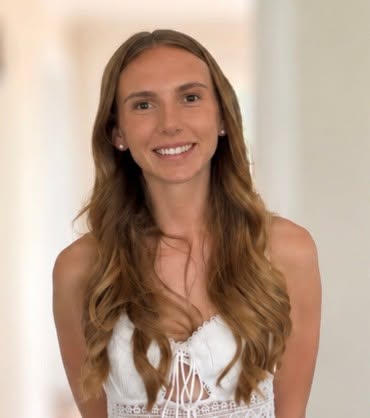

When Grace Weekley was 14, she began losing her vision without
explanation. For years she cycled through steroid medications that helped, but came
with side e?ects severe enough to end the activities that filled her teenage years.
Now 21, Grace’s condition is stable, and she is off multiple medications, thanks to
ANU’s newly opened Centre for Personalised Medicine (the Centre), the first of its kind
in Australia, which identified precisely which treatment her body needed and which it
didn’t.
“For so long, I was on different steroid medications, which were helping but the side
effects were horrible. I had to give up playing sport or doing anything active, and as a
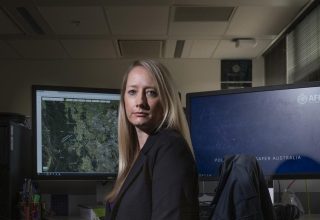
teenager, that really affected me. Finally, we were referred to Dr Jiang (Director of the
Centre), whose research validated that one of the medications I was on was safe and
effective long term, and I could drop off the others. It helped me to recognise myself
again – it was a godsend,” Grace said.
“I was so lucky to have been seen by amazing doctors, who did everything they could to
treat me (and did provide the medicine I needed to be on), but they could only do so
much. The doctors at the Centre for Personalised Medicine were able to go further and
determine exactly what I needed based on my genetics,” Ms Weekley said.
To bolster its research capability and help more people from across Australia access
personalised medicine like Grace, ANU is encouraging junior clinicians to undertake the
Zinkernagel Medical PhD Scholarship.
The scholarship, named in honour of ANU Nobel Laureate Professor Rolf Zinkernagel,
who won the 1996 Nobel Prize in Physiology or Medicine and completed his own PhD at
the John Curtin School in 1975, will award $70,000 a year to a junior clinician
undertaking a PhD in the Centre’s Personalised Medicine and Autoimmunity Laboratory.
Rather than relying on trial-and-error prescribing, the Centre uses cutting edge science
to identify the precise cellular and genetic cause of a patient’s illness, then tailors
treatment accordingly. It supports patients from across Australia with severe, complex
autoimmune and genetic disorders, including rheumatoid arthritis, inflammatory bowel
disease, lupus and myositis.
“Through the Zinkernagel Scholarship, we are investing directly in junior clinicians who
are passionate about research. By training them in advanced genomics and
personalised therapies, we are empowering them in these highly specialised, life-saving
treatments, thereby transforming patient outcomes nationwide,” Associate Professor
Jiang said.
Applications are now open to junior clinicians,



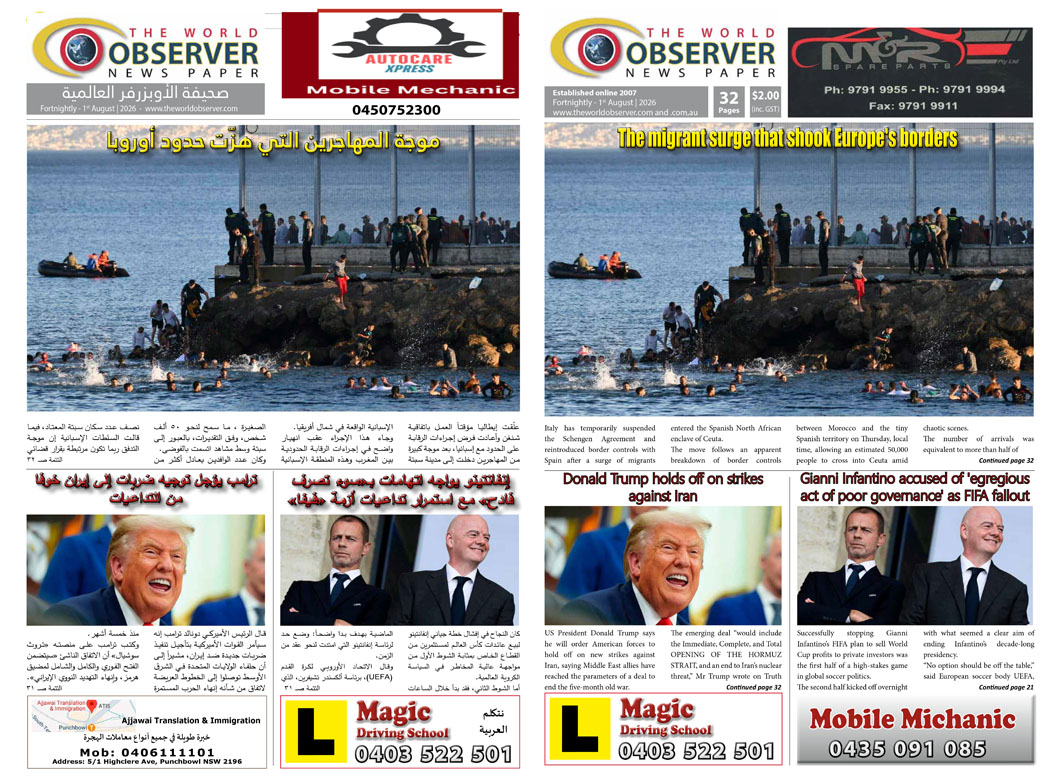
























 The World Observer Media produces a daily online newspaper, a daily Arabic online newspaper and a monthly printed Arabic/English magazine and a weekly printed Arabic/English newspaper.
The World Observer Media’s mission is to entertain and educate all generation from the Ethnic Communities in Australia, who are interested in local, national and foreign information.
The World Observer Media produces a daily online newspaper, a daily Arabic online newspaper and a monthly printed Arabic/English magazine and a weekly printed Arabic/English newspaper.
The World Observer Media’s mission is to entertain and educate all generation from the Ethnic Communities in Australia, who are interested in local, national and foreign information.