
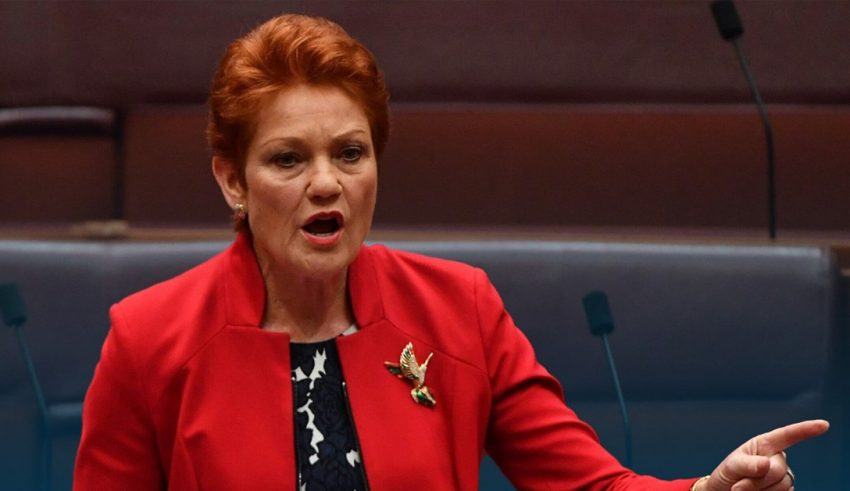

Australia’s university lobby has accused One Nation of “joining the conga line” with the government and Coalition on populist jockeying, in a crackdown on international students that would leave the country poorer and less skilled.
One Nation has proposed cutting international student numbers by hundreds of thousands, with party leader Pauline Hanson calling universities “visa factories”.
“One Nation are just joining the conga line in this furphy, which is blaming international students for all things to do with the migration debate. And it’s just frankly wrong,” Universities Australia CEO Luke Sheehy told ABC News.
The proposal would slash international student places from 590,000 to 350,000, and cut the number of graduates who wished to remain in Australia after their studies from 270,000 to 40,000.
“If numbers actually materialised as One Nation proposed … you would see university campuses shut down, Australian students unable to get a place at university and thousands of university workers have their jobs put at risk,” Mr Sheehy said.
Phil Honeywood, a former state Liberal MP in Victoria, who runs the International Education Association of Australia and has clashed with Senator Hanson over decades, was also scathing of the proposal.
“For 30 years, Pauline Hanson has been attacking Asians, attacking Muslims, and now attacking young people that just want to come to Australia and get a world-class qualification,”
Mr Honeywood said.
Phil Honeywood has clashed with Pauline Hanson for decades.
He said the policy would, in addition to the financial hit on universities, limit Australia’s future influence in the region.
“We’d rather have young Australians working with, studying with young people from our own region, who then go back to their home countries and become future leaders rather than another country,” Mr Honeywood said.
Universities have long relied on international students to cross-subsidise domestic student places, especially since the introduction of a policy called Job Ready Graduates, introduced by the Coalition in 2020, which changed the amount universities were paid to teach.
“International students help subsidise the experience of the nearly one million Australian students right across the system. For many, many years, the federal treasury and the federal government have got a cut-price deal on how much they have to spend on universities,” Mr Sheehy said.
“It’s not just for medicine, it’s for disciplines like engineering, science, health sciences, humanities, you name it.”
Luke Sheehy says student fees were the bedrock for universities being able to carry out research.
The same is true for Australia’s research effort, where universities often receive only a portion of the total cost of carrying out research.
“It is the bedrock of the way that we do so much of our research in our universities. The fees that students pay link directly to the amount of research Australian universities can do,” Mr Sheehy said.
“Australian universities are doing the lion’s share of research and development in Australia right now. So frankly, if you slash the number of international students, you’re actually putting at risk Australia’s overall R&D effort, which is economically reckless.”
International students make up more than a quarter of revenue
Director at the University of Melbourne’s Centre for the Study of Higher Education, Professor Chris Ziguras, said international student fees amounted to more than a quarter of the sector’s total revenue.
“So, they are more than a quarter of all of our students, and they’re also more than a quarter of the revenue of the system totally,” Professor Ziguras said.
“The most recent data we’ve got from 2024 and the international student fees comprised about 27 per cent of all the income of the system as a whole.”
Christopher Ziguras says there is “a lot of populist jockeying” jeopardising long-standing bipartisan policies.
International student numbers have reached record highs in recent years, rising after the pandemic.
That led to questions about universities’ social licences, as some institutions approached 50 per cent of the student body being made up of international students.
Professor Ziguras said there was “a lot of populist jockeying” going on, which was jeopardising long-standing bipartisan policies.
“Both temporary and permanent immigration to Australia is essential for all sorts of sectors, and it’s part of how our society runs, and that’s not a new thing,” Professor Ziguras said.
“We’ve been teaching international students in Australia for many decades, just as farmers have been relying on backpackers and seasonal workers.”
The government introduced caps on international student numbers two years ago, but the sector is braced for the government and Coalition to cut further.
Vicki Thomson, the CEO of Australia’s Group of Eight, which represents Australia’s research-intensive universities, also hit out at the One Nation announcement.
“You do not strengthen Australia’s future by shrinking one of our largest exports, weakening our research engine and sending the world’s best students to our competitors,” Ms Thomson said.
“Countries that attract talent prosper. Countries that drive it away pay the price.”
ABC































 The World Observer Media produces a daily online newspaper, a daily Arabic online newspaper and a monthly printed Arabic/English magazine and a weekly printed Arabic/English newspaper.
The World Observer Media’s mission is to entertain and educate all generation from the Ethnic Communities in Australia, who are interested in local, national and foreign information.
The World Observer Media produces a daily online newspaper, a daily Arabic online newspaper and a monthly printed Arabic/English magazine and a weekly printed Arabic/English newspaper.
The World Observer Media’s mission is to entertain and educate all generation from the Ethnic Communities in Australia, who are interested in local, national and foreign information.