


A decision on whether to extend the fuel excise rebate that is offering relief at the bowser will not be made until next week, with Prime Minister Anthony Albanese saying he will give Australians “appropriate notice”.
Mr Albanese welcomed news that the United States and Iran had agreed to a ceasefire deal to end the war, stating it was in the interest of every country, not just Australia, for the “agreement to stick”.
The prime minister said the government was yet to make an assessment over how the deal, which is set to be signed in Switzerland on Friday, would impact the decision to extend the fuel excise rebate, which slashed 26 cents per litre for motorists for three months.
The rebate, which was halved in April in a bid to tackle soaring global oil prices following the closure in the Strait of Hormuz, is set to expire on June 30.
The prime minister said the expenditure review committee would reconvene over the issue early next week so Australians had “appropriate notice”.
Mr Albanese said it would be “many months” before things returned to normal once the Strait of Hormuz reopened, but the government continued to monitor the situation.
“So whilst we want to see the conflict end and we hope that that has occurred, we also want to be very conscious of the fact that that doesn’t mean that everything returns to normal in just a day, or indeed a week or even a month,” he said.
The government also made no mention of the heavy road user charge, which was reduced to zero for the same period to take pressure off truck drivers and transport costs.
The temporary measures have cost the budget $2.5 billion.
The government has carved out more than $10 billion to bolster Australia’s fuel and fertiliser security.
It includes stockpiling about 1 billion litres of diesel and jet fuel by establishing a government-owned fuel reserve, increasing minimum stock-holding obligations for suppliers, and underwriting international fuel purchases to prevent shortages.
Asked about the rise of One Nation, Mr Albanese said his government’s ability to negotiate successfully with Asian countries had made an “enormous difference” in its ability to respond to the fuel crisis.
“Think about the global fuel crisis that just occurred, and think about whether everyone in public life would be in a position to go to our Asian friends in Singapore, in Brunei, in Malaysia, in China, in South Korea and Japan and say we have a relationship that is important of mutual interest in our region,” Mr Albanese said.
“That hasn’t happened by accident. That’s happened due to relationships and by good policy through the use of Export Finance Australia to purchase fuel on the spot market. That’s what serious political parties of government are able to achieve when they’re focused on the needs of the Australian people.”
Mr Albanese and Energy Minister Chris Bowen have repeatedly highlighted that Australia has more fuel, petrol and diesel than before the conflict began.
Taylor weighs in on fuel extension call
Opposition Leader Angus Taylor praised the ceasefire deal as a “good thing”.
“It means it will bring down the price of fuel at the bowser. That is what we have all wanted to see,” he said.
Asked whether the government should extend the rebate, Mr Taylor said he would wait to see how fuel prices reacted over the coming days.
“The crude oil price at least has come down overnight, and we’d expect that to flow through to the bowser. But let’s see if it’s sustained,” he said.
With details of the US-Iran deal not yet public, Mr Taylor said he hoped it included parameters around Iran’s nuclear capabilities.
“We also want to see a peace deal where the Iranian people are able to live their lives as they want to live them, but also that the rest of the world is secure and the nuclear capability that Iran has been building cannot be resumed,” he said.
In a statement this morning, Mr Albanese said resolving those long-term concerns were critical to ongoing dialogue and diplomacy.
“Iran must address longstanding concerns about its nuclear program and the threat it poses to international security,” he said.
“Australia will continue to engage with international partners to promote peace, stability and security in the Middle East.”


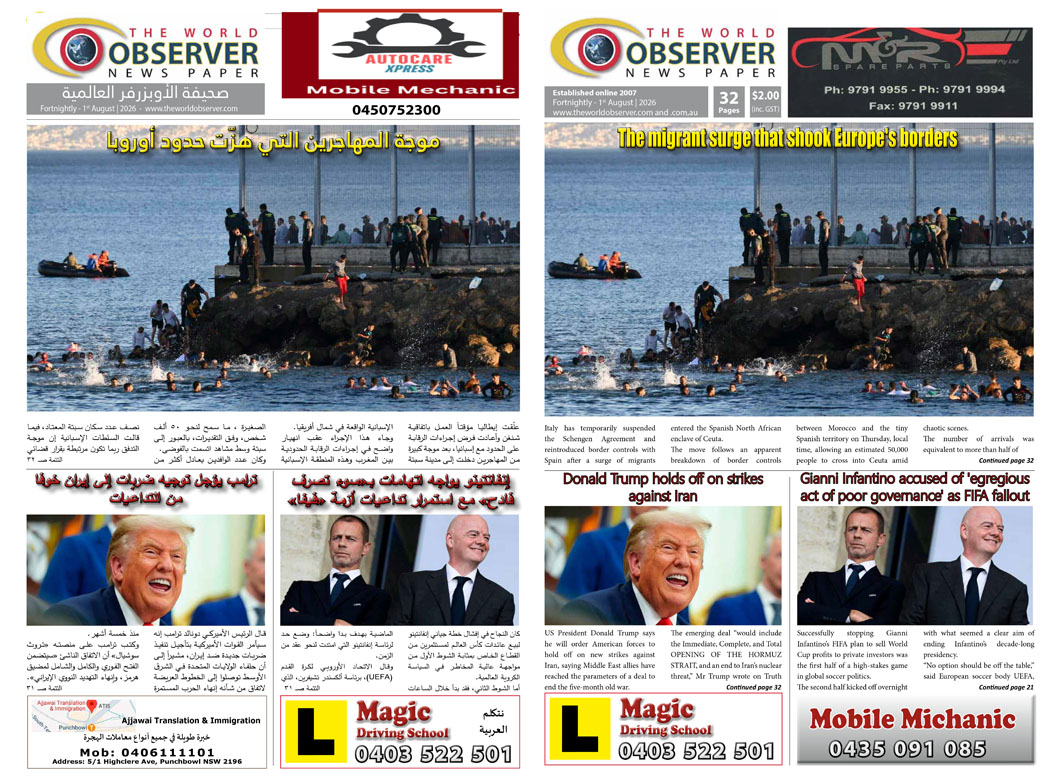


























 The World Observer Media produces a daily online newspaper, a daily Arabic online newspaper and a monthly printed Arabic/English magazine and a weekly printed Arabic/English newspaper.
The World Observer Media’s mission is to entertain and educate all generation from the Ethnic Communities in Australia, who are interested in local, national and foreign information.
The World Observer Media produces a daily online newspaper, a daily Arabic online newspaper and a monthly printed Arabic/English magazine and a weekly printed Arabic/English newspaper.
The World Observer Media’s mission is to entertain and educate all generation from the Ethnic Communities in Australia, who are interested in local, national and foreign information.