
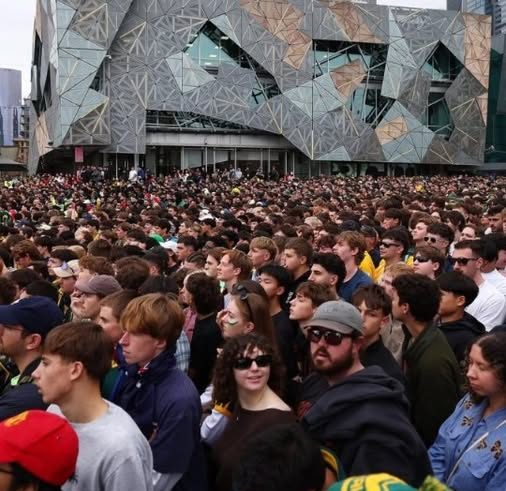

A World Cup campaign that brought Australians together across cultures, languages and backgrounds
For a few unforgettable weeks, the Socceroos gave Australia something more than football. They gave the nation a shared experience — one that crossed cultural, social and generational boundaries.
From cafés and pubs to living rooms, community centres and public spaces, Australians gathered to watch their national team take on the world. People who normally supported different international teams suddenly found themselves standing together, cheering for the green and gold.
In a café in Canberra’s Harrison suburb, conversations about England, Brazil and Argentina gave way to a single focus when the Socceroos faced Egypt in a tense penalty shootout. The usual differences between supporters disappeared. For those crucial moments, there was only one team everyone wanted to see succeed: Australia.
That is the power of sport.
The Socceroos’ World Cup journey demonstrated that belonging does not require Australians to share the same background, culture or traditions. In fact, Australia’s strength lies precisely in its diversity.
The World Cup brought together people from different communities who may speak different languages at home, follow different religions and have roots in countries around the world. Yet when the Australian team played, they shared the same excitement, anxiety, pride and disappointment.
These moments remind us that Australian identity is not about uniformity. It is about creating a sense of belonging while allowing people to maintain the cultures and traditions that make them who they are.
After more than three decades in Australia, one thing is clear: belonging cannot simply be created through slogans or official statements. It grows through everyday experiences — through friendships, workplaces, schools, neighbourhoods, community events and, sometimes, through something as simple as watching a football match together.
The Socceroos gave Australians those moments.
They reminded us that we can come from different places and still share the same home.
Football achieved something that often seems difficult in our public debate. It reminded us that we have far more in common than the headlines sometimes suggest.
Public discussion about multiculturalism is often framed around difference. We hear arguments about cultural division, social fragmentation and whether Australia has become too diverse. Yet those debates rarely reflect the Australia that most people experience every day.
The Australia I know is one where neighbours help one another, volunteers work side by side, parents stand together at school sporting events and communities rally around those in need. It is an Australia where people from different backgrounds build friendships not because they are the same, but because they share common experiences and common values. Football simply makes those connections visible.
The Socceroos themselves embody modern Australia. Their family histories stretch across many continents, yet when they pull on the green and gold, Australians see only one team. Nobody asks where a player’s parents were born before celebrating a goal or applauding a tackle.
That offers an important lesson. Strong teams are not built by making everyone identical. They are built by creating trust, shared purpose and mutual respect. Nations are no different.
As someone who migrated to Australia in 1992, I have witnessed that spirit. Through volunteering, community leadership and countless conversations with people from every walk of life, I have learned that belonging cannot be legislated. It grows through everyday encounters, working together, celebrating together and sometimes even sharing disappointment together.
Australia has never been one story. It has always been many stories woven together.
That diversity is not a weakness to be managed. It is one of Australia’s greatest strengths. Our different histories, cultures and experiences enrich our communities while our shared democratic values give us a common foundation.
The World Cup reminded us that national identity does not require uniformity. For a few unforgettable weeks, millions of Australians stood behind the same team. We celebrated together, we suffered together and we hoped together.
We did not stop being different. We simply remembered that we belonged to the same team.
Perhaps that is the Socceroos’ greatest legacy from this World Cup. Not only the football they played, but the reminder that a strong and confident Australia is one where people from different backgrounds can unite around a shared purpose without giving up who they are.
Long after the final whistle, that will remain my lasting memory of this World Cup.
We recognise the First Peoples of this nation and their ongoing connection to culture and country. We acknowledge First Nations Peoples as the Traditional Owners, Custodians and Lore Keepers of the world’s oldest living culture and pay respects to their Elders past, present and emerging.























 The World Observer Media produces a daily online newspaper, a daily Arabic online newspaper and a monthly printed Arabic/English magazine and a weekly printed Arabic/English newspaper.
The World Observer Media’s mission is to entertain and educate all generation from the Ethnic Communities in Australia, who are interested in local, national and foreign information.
The World Observer Media produces a daily online newspaper, a daily Arabic online newspaper and a monthly printed Arabic/English magazine and a weekly printed Arabic/English newspaper.
The World Observer Media’s mission is to entertain and educate all generation from the Ethnic Communities in Australia, who are interested in local, national and foreign information.